From Sea Waste to Circular Solutions
What the Circular Economy Really Means at Healthy Seas
Protecting the Ocean, One Net at a Time
From the start, Healthy Seas was created with a vision that connects ocean conservation with circular economy. Our payoff—“a journey from waste to wear”—reflects this DNA. One of our founding partners was Aquafil, the company behind ECONYL® regenerated nylon. Their groundbreaking process made it possible to turn waste like fishing nets and other discarded nylons into new, high-quality products.
We don’t do the recycling—that’s Aquafil’s expertise. But we ensure that marine waste is not just collected, but reintegrated into value chains, educational programs, and public awareness.
Together with our partners, we recover discarded fishing nets and other marine litter, prevent pollution before it starts, and bring circularity to life through innovation, collaboration, and education.
Why Circular Economy Matters—For the Ocean, and the Planet
The climate crisis, biodiversity loss, and plastic pollution are deeply interconnected—and the ocean is at the heart of them all.
Each year, more than 8 million tonnes of plastic enter the ocean (Jambeck et al., Science, 2015). Ghost gear—abandoned fishing nets and lines—makes up a deadly share, entangling marine life and damaging ecosystems.
The root problem? Linear systems. We take, make, use, and discard—generating massive waste and emissions.
The circular economy offers a better way: keeping materials in use, designing out waste, and regenerating nature. Yet we’re far from circular:
- The Circularity Gap Report 2024 shows that only 6.9% of the global economy is circular—down from previous years.
- In textiles, just 0.3% of materials come from recycled fabrics, with almost no textile-to-textile recycling occurring today. (source).
These numbers show that recycling alone isn’t enough. We need smarter systems and earlier interventions. In the marine space, circular solutions can reduce overfishing, support biodiversity, and strengthen coastal economies.
A Silent Threat: From Ghost Nets to Microplastics
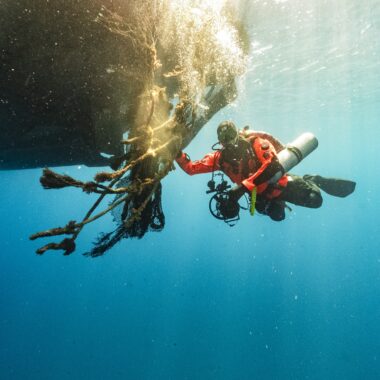
Ghost nets don’t vanish—they disintegrate. As they break down, they release microplastics: tiny, persistent particles now found in deep-sea life, table salt, and even human blood.
By removing these nets early, we’re not just protecting marine animals—we’re preventing microplastic pollution at one of its sources.
Healthy Seas and Circular Economy in Action
Healthy Seas acts as a bridge between the problem—marine litter—and the solutions. Here’s how:
- Enabling Regeneration: ECONYL® Yarn by Aquafil
Nylon nets we recover—if clean and suitable—go to our partner Aquafil, inventor of the ECONYL® Regeneration System. This is a chemical recycling process that turns nylon waste (including fishing nets, carpets, and textile scraps) into regenerated nylon with the same quality as virgin materials—minus the fossil resources.
Used for: Swimwear, socks, carpets, bags, and activewear. [Shop ECONYL®]
- Giving New Life to Non-Regenerable Materials
Not all nets can become ECONYL® nylon. Those made from polyethylene or polypropylene follow different paths:
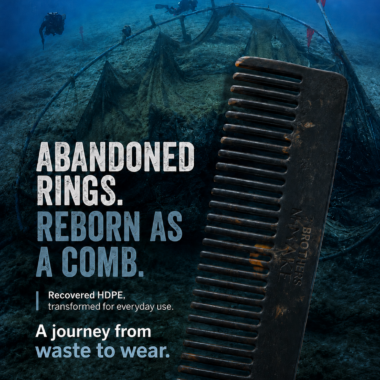
- Recycled into accessories by Bracenet
- Repurposed for exhibits or installations
- Downcycled locally for construction materials
At ghost farms, we also recover pipes, cages, and buoys—many reused by industry or recycled locally. It’s not perfect circularity, but it avoids landfill and ocean leakage.
- Designing Circular Products from the Start
Together with Aquafil, our partner Diopas developed the first recycled and recyclable fish farming net, now being tested in real conditions. If successful, this net could be reused for years and then fully recycled—closing the loop without using virgin resources.
This is what true circularity looks like: design-led, scalable, and systemic.
- Educating for Circular Futures
Circularity is also a mindset. That’s why education is a core pillar of our work.
- We develop content for Eco-Schools in Slovenia with Aquafil SLO, teaching students aged 6–18 about marine pollution and circular design.
- We run workshops for fashion and design students, exploring material choices, product lifecycles, and sustainability principles.
One standout example: a fashion competition co-organized with MEDASSET, AKTO College of Art and Design, and DoitEco Project. Ten young designers created outfits using textiles woven with ECONYL® yarn. Each participant developed one artistic and one wearable outfit, and the public helped judge the winners. The top designs were showcased in public events, merging fashion and conservation.
We also worked with artist Nikki Steenbergen to create a seahorse mascot costume made entirely from marine litter and textile scraps—complete with rotating eyes! It now visits schools and events, captivating children while teaching circularity in a memorable way.
When students can hold—or wear—a product made from ocean waste, circularity becomes real.
Circular Economy Is Not Just Recycling
It’s a common misconception: recycling alone isn’t circular. A truly circular economy starts with prevention and includes reuse, regeneration, and thoughtful design.
That’s why we also work upstream—with fishers and fish farmers—to recover nets before they’re lost, or support reuse and proper disposal. It’s about creating systems that work, not just managing waste after the fact.
Join the Circular Wave
Protecting the ocean demands more than good intentions—it requires action, systems, and collaboration. At Healthy Seas, we connect innovators, recyclers, educators, and industry to drive that change.
If you’re looking to support a practical, inspiring, and scalable example of the circular economy in action—get in touch. Let’s build a circular future, from sea to store, together.
Some related resources to watch
Hyundai and Healthy Seas Mission to Clean Up
A BBC short documentary
The Healthy Seas foundation, in co-operation with major partners like Hyundai Motor Company, is on a mission to clean up “ghost gear” while raising awareness about protecting the ocean environment.

Designing Circular Futures: Inside Our Collaboration with Eco-Schools Slovenia and AquafilSLO
A short video about the partnership in schools
A new video offers a behind-the-scenes look at how we’re inspiring the next generation of circular designers—starting from the classroom.