Healthy Seas Pushes Accountability Forward in Ghost Farms Case in Greece
Press Release
Athens, May 26th, 2026. Abandoned aquaculture structures previously documented near Modi in western Greece have now been removed by the operator and reportedly sent for recycling, following weeks of coordinated engagement between the Healthy Seas Foundation, public authorities, and increased scrutiny surrounding ghost farms in the Ionian Sea.
For Healthy Seas, the case represents a significant shift in how abandoned aquaculture infrastructure may be addressed in Greece: not only through direct cleanups carried out by NGOs, but through strategic pressure, institutional accountability, and coordinated engagement leading operators themselves to take action.
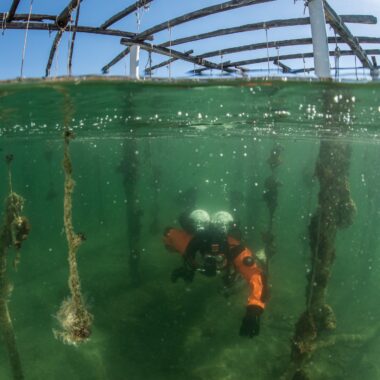
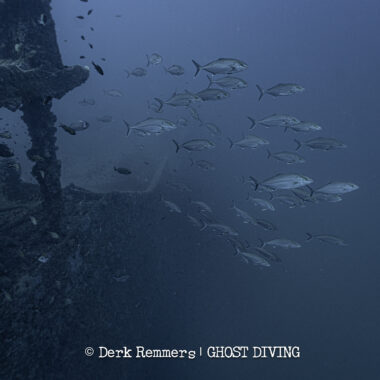
Healthy Seas had first identified the abandoned status of the Modi site several years ago through surveys carried out together with Ghost Diving Greece and in cooperation with the Greek NGO OZON as part of ongoing ghost farms monitoring activities in Greece. During those surveys, four aquaculture rings had been documented at the site, which had already been considered inactive and abandoned in practice.
The situation escalated in February 2026, when a large fish farm ring was detected drifting through the Ionian Sea before eventually ending up near Ithaca, after entering a ferry shipping lane used by passenger vessels travelling through the area. Due to concerns over maritime safety, the structure was intercepted by the Coast Guard and brought ashore.
Following the incident, Healthy Seas immediately mobilized to investigate the possible origin of the drifting structure. Based on previous surveys, the organization identified a possible connection with the abandoned Modi site. The type of the ring was highly distinctive and uncommon in the region, making the possible connection difficult to ignore.
Healthy Seas did not approach the incident as a standalone cleanup operation. Alongside removing and facilitating the recycling of the ring recovered in Ithaca, the organization escalated the issue strategically through continuous engagement with authorities, increased public visibility around the broader ghost farms issue, and formal correspondence addressed to all competent authorities, informing them of the situation and calling for institutional action.
Shortly afterwards, the Coast Guard conducted a new survey of the Modi site and confirmed that the structures previously documented there for years, including the period when the drifting ring incident happened and Healthy Seas’ pressure around the case intensified, had now been removed. According to the authorities, the operator informed the Coast Guard that the structures had been eventually transferred to a recycling company.
Although the operator reportedly did not accept that the drifting ring originated from its facility, the abandoned structures previously documented at the Modi site were nevertheless removed shortly afterwards and reportedly sent for recycling.
While Healthy Seas cannot formally establish a direct causal link between these developments, it is difficult to consider this sequence of facts as a coincidental rather than the result of coordinated and strategic pressure surrounding the case. At the same time, regardless of the origin of the drifting ring itself, the outcome remains clear: one more ghost farm has now been removed from the Greek seas.
For Healthy Seas, this case illustrates the importance of sustained monitoring, strategic escalation, institutional engagement, and coordinated pressure in driving accountability around abandoned aquaculture infrastructure. The structures had remained abandoned for years. Their removal occurred only after the drifting ring incident near Ithaca, the subsequent investigation by Healthy Seas, continued engagement with authorities, media exposure surrounding the case, and formal institutional escalation.
“For years, our work has focused primarily on physically removing abandoned aquaculture infrastructure from the sea,” said Veronika Mikos, Director of Healthy Seas. “What makes this case significant is that it demonstrates another possible pathway: strategic engagement, institutional pressure, and coordinated action that may encourage operators to take responsibility themselves before these structures become even larger environmental or maritime hazards.”
The case also highlights a broader reality increasingly visible across parts of the Mediterranean: aquaculture infrastructure can remain inactive in practice for years while still existing operationally on paper. Over time, abandoned structures may deteriorate, drift, and become hazards for navigation, tourism, and marine ecosystems.
“This is not only a marine litter issue,” added Mikos. “The drifting ring near Ithaca demonstrated that abandoned aquaculture infrastructure can also become a maritime safety issue in heavily trafficked seas such as those around Greece. Preventing these situations requires monitoring, accountability, and timely decommissioning before structures break loose.”
Over the past five years, Healthy Seas, together with partners and supporters including Hyundai Motor Europe, has collaborated with local authorities, divers, fishers, researchers, and recycling partners to address abandoned aquaculture infrastructure in several locations across Greece, including Ithaca, Patras, Menidi, and Methana.
For Healthy Seas, the Modi case represents an important evolution in the broader ghost farms discussion in Greece. Success is not measured only by the structures physically removed by the organization itself, but also by situations where sustained advocacy, monitoring, institutional engagement, and coordinated pressure contribute to responsible action being taken before environmental risks escalate further.
Healthy Seas hopes the Modi case may signal a gradual shift toward more proactive responsibility, monitoring, and decommissioning practices within the aquaculture sector.
About the Healthy Seas Foundation
The Healthy Seas Foundation is dedicated to safeguarding the world’s oceans through cleanups, education, and prevention. Since 2013, the organization has collected over 1,309 tons of marine litter (2013-2025) with the help of more than 550 volunteers and 150 partners.