Who Owns Marine Litter?
Reflections from the 10th Our Ocean Conference in Busan
At the 10th edition of the Our Ocean Conference (OOC)—held this year in Busan, Republic of Korea—Healthy Seas had the honor of not only organizing its own official side event but also participating in another high-level panel hosted by Ocean Conservancy. Across both sessions, one theme stood out clearly: in short, if you want to go fast, go alone. But if you want to go far, go together—as the Korean saying goes.
This wisdom echoed across the conference halls in Busan, reminding us that collaboration, shared knowledge, and aligned goals are the only way to tackle challenges as complex as marine litter.
Healthy Seas’ Panel on Ownership and Accountability
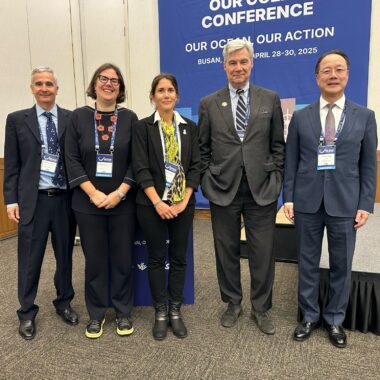
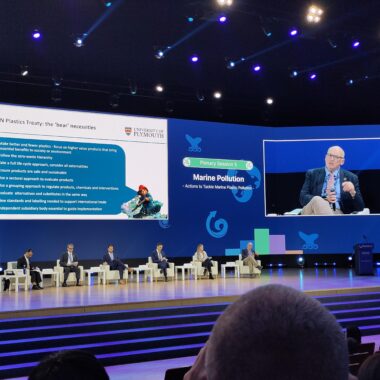
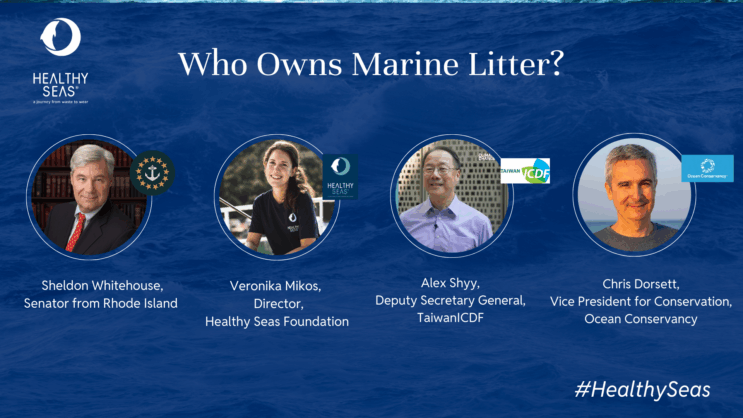
On April 28, Healthy Seas brought together a diverse panel of international speakers for a provocative discussion titled:
“Who Owns Marine Litter? Legal, Policy, and Field-Based Perspectives on Ownership and Accountability.”
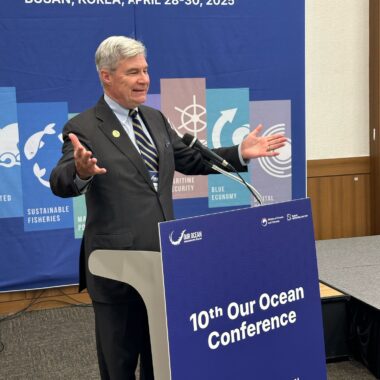
The session opened with remarks by Senator Sheldon Whitehouse, who, notably, was the only active U.S. political representative present at this year’s OOC. His speech reflected on past commitments, including a pledge by Nestlé at OOC Oslo to recover as much plastic as they produced—a promise that echoed the broader need for systemic responsibility.
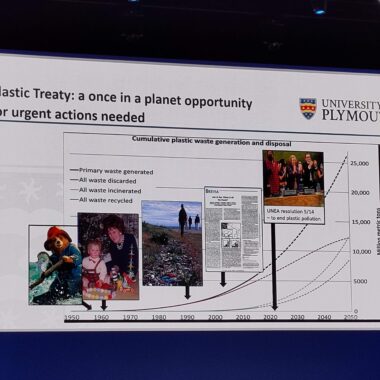
The Senator also emphasized the opportunity of the Global Plastics Treaty, underlining that leadership, innovation, and international collaboration must come together to make it a reality. If the “Coalition of the willing” can move forward despite opposition, it can unlock real progress.
Following his remarks, our panelists—Veronika Mikos (Healthy Seas), Alex Shyy (TaiwanICDF), and Chris Dorsett (Ocean Conservancy)—explored this question from three angles: field experience, development cooperation, and international law.
Some Highlights:
- Veronika Mikos dove into the issue of abandoned fish farms in Greece, where ownership is technically clear, but enforcement is missing, and cleanup efforts are blocked by procedural gridlock. This case challenges the assumption that clarity in ownership leads to action.
- Alex Shyy brought lessons from Small Island Developing States, such as St. Kitts and Nevis and the Marshall Islands, where outdated legal frameworks and lack of coordination severely limit the effectiveness of recycling and waste management. These nations, despite limited capacity, have critical knowledge to contribute—especially as large ocean states deeply affected by plastic pollution.
- Chris Dorsett provided a global policy lens, underscoring how fragmented mandates between platforms like FAO, IMO, and ILBI make it difficult to address ghost gear. He warned that unless ghost fishing gear and abandoned infrastructure are included in the Global Plastics Treaty, the treaty risks falling short.
Six Key Ingredients for Action on Ghost Gear
During our side event, Chris Dorsett of Ocean Conservancy emphasized that while the challenges of ghost gear are complex, we are not starting from zero. “There’s no silver bullet,” he said, “but we do know what’s needed to make progress.” He shared six key components that, taken together, form a strong foundation for effective implementation of global interventions—whether through national programs or international frameworks like the Global Plastics Treaty.
Here’s a recap of the six pillars he outlined:
- 1: We need to understand the drivers of gear loss in order to tailor practical and appropriate measures to prevent, mitigate and remediate the occurrence and impacts of ghost gear from local action through to international policy recognizing that the challenges and priorities relating to plastic pollution, including ghost gear vary across geographic scales.
- 2: Given the scope and scale of the problem, collaboration amongst the different sectors of the seafood supply chain is essential as is trans-boundary collaboration between countries. This includes the sharing of information, including lessons learned and success stories that help strengthen effective interventions. In addition collaborative planning and action is necessary across all actors within the seafood supply system given each has an important role to play in success.
- 3: Effective implementation to address ghost gear will take resources. Sustainable financial mechanisms are paramount to ensure nations are supported to effectively implement measures.
- 4: We must work towards aligning policies and regulations at the national, regional, and international levels to address ALDFG effectively. As just discussed the plastics treaty can create a comprehensive framework at the international level. Regional and national action plans for the management of ghost gear including best practices tailored specifically for local circumstances are important and is something we have worked with countries to develop.
- 5: Additionally, establishing mechanisms and tracking tools for monitoring and evaluating the impact of interventions aimed at addressing ghost gear will help assess progress, identify areas for improvement, and ensure accountability. For example, we are currently evaluating how we could further develop the global ghost gear data portal – the only repository of its kind housing disparate data sets on ALDFG and end-of-life gear – to support nations in their lost gear reporting requirements for example.
- 6: It is also necessary to highlight the importance of a thoughtful transition to support countries and communities at all levels when implementing policies, including artisanal, small-scale, and traditional fishers, and the communities that depend on fishing.
Ghost Gear in the Spotlight: Ocean Conservancy’s Panel on April 30
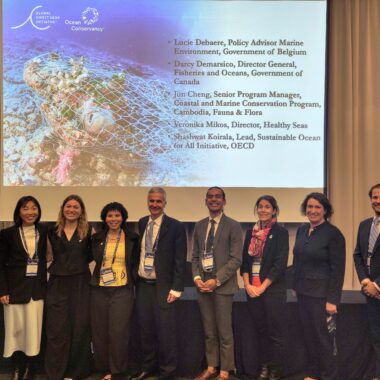
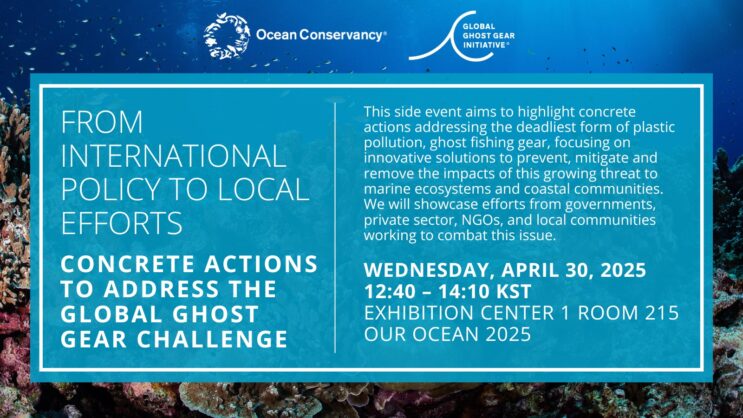
Two days later, Healthy Seas also contributed to a second panel titled:
“Marine Plastic Pollution: Addressing Ghost Gear through Innovative Action and Global Solutions”
In this session, hosted by Ocean Conservancy and featuring representatives from governments, NGOs, and international institutions, the focus was squarely on ghost gear—the deadliest form of plastic pollution in our seas.
Veronika Mikos spoke about the social and ecological impacts of abandoned fish farms especially among coastal communities in Greece. Other speakers shared how governments are stepping up: Korea, for example, showcased national strategies involving citizen science and cutting-edge technology to detect and remove marine litter. These approaches offer a blueprint for national-level action, even before global treaties are finalized.
From Policy Gaps to Collective Action
A recurring question across multiple sessions was:
“What do we do when policies don’t yet exist to support marine litter solutions?”
Some of the interesting answers we collected?
💡 Align your project with national policy priorities.
💡 Connect land-based waste to marine pollution, and marine pollution to sustainable fisheries, livelihoods, and tourism.
💡 Quantify and make your impact visible with visuals and numbers.
💡 If ghost gear isn’t a top priority, frame it within broader themes like sustainable fisheries.
💡 Leverage media to build public and political momentum.
In short, if you want to go fast, go alone. But if you want to go far?
You need partnerships, long-term strategy, and a shared commitment to progress.
Why the Question “Who Owns Marine Litter?” Matters
At first glance, “Who owns marine litter?” may seem like a rhetorical provocation. But it’s more than that.
In many cases, marine litter has no legal owner—and so, no one is responsible.
In others, ownership is known—but enforcement is missing, bureaucracies are overwhelmed, and cleanups are stalled.
And even where solutions exist, there’s no system in place to finance them.
That’s why this question is foundational for the circular economy and for implementing Extended Producer Responsibility (EPR).
It also touches the heart of the upcoming Global Plastics Treaty: If no one owns the waste, no one is accountable—and no circular solution can begin.
From Sea to Stage: Diving in Pohang
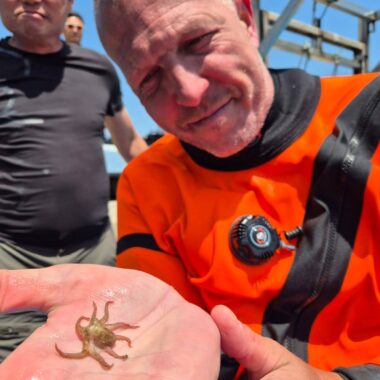
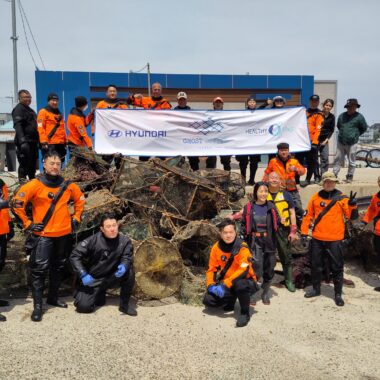
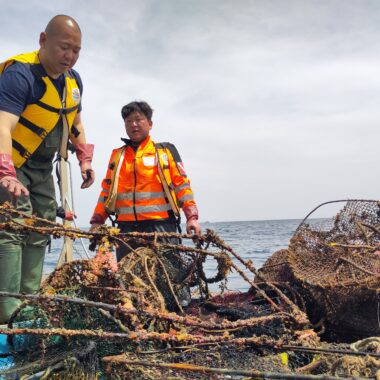
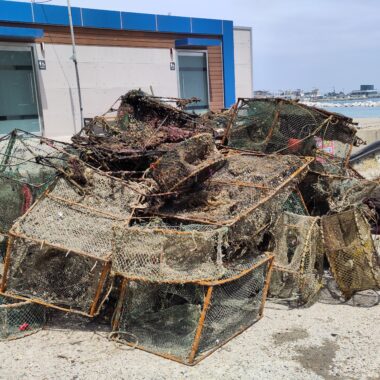
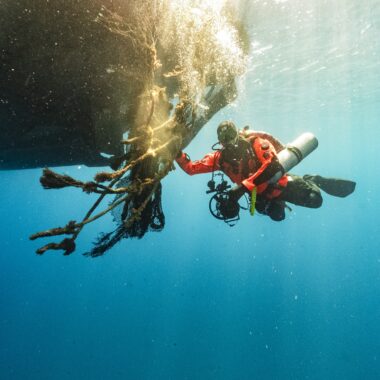
Before stepping onto the stage at the Our Ocean Conference, Healthy Seas led a cleanup mission in the coastal city of Pohang. Over the course of three dives in two days, our team—joined by nearly 20 volunteer divers from the Ghost Diving Korea team—recovered an astonishing 63 abandoned crab cages from the seafloor. The effort reflects our field-based approach to marine protection, where local action fuels global advocacy. A small group of those divers even joined us in Busan for the conference, helping us carry the voice of the ocean directly into policy discussions.
What’s Next?
Healthy Seas will continue the conversation in an upcoming webinar focused on:
- Legal tools in marine conservation
- Rights of the ocean
- The role of public-private partnerships in overcoming regulatory deadlocks
- Lessons from countries and communities already acting
REGISTER HERE join us in shaping the future of marine protection—together.
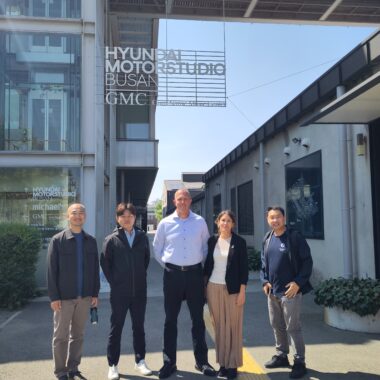
A special thank you to Hyundai, whose long-standing support made both our OOC participation and the pre-conference cleanup mission in Pohang, Korea, possible. Their commitment continues to power our work from field to policy.