Healthy Seas and Hyundai take ocean action beneath the surface in Türkiye
After engaging students and employees earlier this year, the second phase of Healthy Seas and Hyundai Motor’s activities in Türkiye moved underwater
From the coast to beneath the surface, our work in Türkiye continued this September with a three-day diving mission in the waters of Çanakkale and Gallipoli.
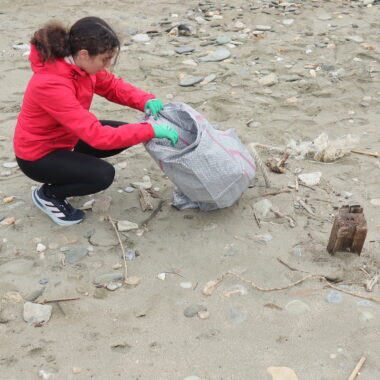
Earlier this year, together with Hyundai Motor, we brought employees, university students and members of the local community together through education and a coastal cleanup along the Black Sea. This second phase tackled another side of the marine litter problem: abandoned fishing gear already lying underwater and entangled around historic wrecks.
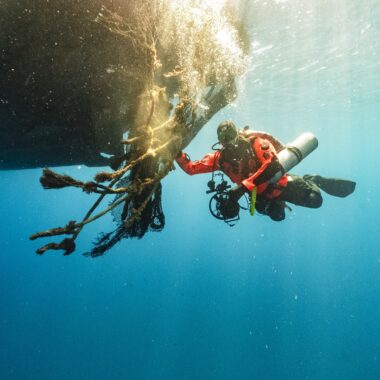
Between 1 and 3 September, a team of seven volunteer divers completed four dives, recovering a total of 105 kg of marine litter, including 86 kg of fishing nets.
But the importance of these dives goes beyond the weight removed.
Where history has become habitat
The Gallipoli Peninsula sits at the entrance to the Dardanelles, the marine corridor connecting the Aegean Sea with the Sea of Marmara. Its waters are known not only for their biodiversity and strong currents, but also for an extraordinary concentration of historic wrecks.
Many of these vessels have now spent more than a century underwater. Over time, they have also become part of the marine environment, providing structure and habitat for fish, invertebrates and other species.
During the mission, the divers worked at:
- Helles Barges on 1 September
- Arıburnu Barge on 2 September
- Lundy and Lighter on 3 September
The Helles Barges once transported troops, supplies, food and ammunition during the First World War. Lundy, originally built as a fishing vessel in 1908, was converted into a minesweeper in 1915 before sinking in Suvla Bay. Today, these and other wrecks across Gallipoli form what can feel like an underwater museum, but also a living marine landscape. That combination makes abandoned fishing gear particularly problematic here.
When fishing gear keeps fishing
Lost or abandoned fishing nets do not stop having an impact when they are left behind. They can continue trapping marine animals, a phenomenon known as ghost fishing, while becoming caught on reefs, wrecks and other underwater structures. As nets deteriorate, they can also fragment and remain in the marine environment for years.
On historic wrecks, their presence creates an additional challenge: removing the gear requires enough technical skill to avoid causing further damage to either the habitat that has developed around the wreck or the wreck itself.
During this mission, small crabs and other small marine animals found among the recovered material were released at the surface.
Seven volunteers, specialised skills
Behind every underwater cleanup is a team of people willing to contribute something that cannot easily be replaced: their time and their expertise. The operation brought together seven volunteer divers, around 80% of whom were local divers, supported by members of the Ghost Diving network.
Working on wrecks means operating in an environment where depth, currents, visibility, entanglement hazards and changing weather conditions all have to be considered. Dive plans can change from one day to the next, and the final choice of sites always depends on what can be done safely.
For Healthy Seas, this is also why local knowledge matters so much. Combining the experience of divers who know these waters with the wider expertise of the Ghost Diving community makes it possible to carry out targeted interventions in places that would otherwise be extremely difficult to reach.
From recovered net to new resource
Of the 105 kg of marine litter recovered during the mission, 86 kg consisted of fishing nets. The nylon fishing nets suitable for regeneration will now be sent to Aquafil, where they can enter the ECONYL® regeneration process and become raw material for new products.
This circular route is an important part of the Healthy Seas model: removing harmful waste from the marine environment is the first priority, but whenever the material allows it, we also want to prevent it from becoming waste again.
The second chapter of our work in Türkiye
The project was led by Healthy Seas with the support of Hyundai Motor Europe, together with Ghost Diving and Gallipoli Wrecks Dive Center, and carried out in close cooperation with the Gallipoli Historical Site Directorate, operating under the Turkish Ministry of Culture and Tourism.
It builds on the first phase of our 2026 activities in Türkiye, which focused on education, employee engagement and coastal action. Together, the two parts tell a broader story about marine litter: prevention and awareness matter on land, but there is also pollution already beneath the surface that requires trained people, specialist equipment and direct intervention. And sometimes, protecting the future of the sea also means taking care of the pieces of history resting on its seabed.
Projects like this are only possible through collaboration between local expertise, volunteer divers, public authorities and committed partners willing to support practical ocean conservation.