When Time Changes the Net: Bringing Science into Ghost Net Removal
A new episode explores what happens when lost fishing gear remains underwater for years and how science can help divers decide on the most responsible intervention.
“Though we try to imagine otherwise, waste is every object, plus time.”
It is the opening line of Brian Thill’s Waste, published in 2015. It is a striking way to think about the objects we discard. But when waste enters the natural environment, time does something else too: it changes the consequences and depth of our intervention.
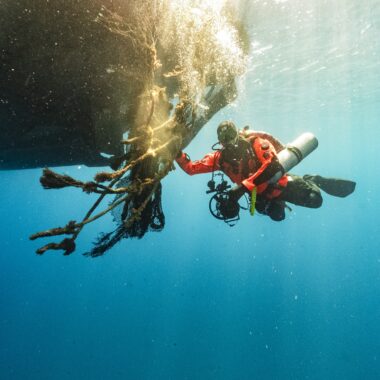
We see this repeatedly in our work at Healthy Seas. An abandoned fish farm left at sea for ten years is far harder to reclaim than one addressed soon after abandonment. Fishing gear becomes entangled in reefs and wrecks, breaks apart, traps wildlife, releases plastic into the environment and, over time, can become physically intertwined with the ecosystem around it. With ghost nets, every day underwater matters.
What happens when we arrive years later?
Ghost nets – fishing nets that have been lost, abandoned or discarded at sea – can continue trapping marine animals long after fishing has stopped. This is particularly true of gillnets, which are made from thin material designed to remain difficult for fish to see underwater. Removing this gear as early as possible can stop that cycle before further damage occurs. But divers do not always find recently lost nets.
Sometimes the gear they encounter has been underwater for years or even decades. And during that time, the environment around it has changed. That observation led Healthy Seas to initiate and fund research with Wageningen University & Research, working alongside Ghost Diving volunteers in the North Sea and Adriatic Sea. The question was deceptively simple: what happens ecologically to ghost gear over time, and how can divers use that knowledge when deciding how to intervene?
Not every net behaves in the same way
One of the clearest findings was the difference between types of fishing gear. Lost gillnets can remain capable of catching and entangling animals. Trawl nets, by contrast, are designed to fish while being pulled behind a vessel. Once lost, their heavier structure often settles on the seabed and there, over a long enough period, something more complicated can happen.
Researchers observed trawl nets colonised by sponges, bryozoans, anemones and corals. In one case on the Vis wreck in Croatia, corals growing on an old net were estimated to be decades old. By that point, removing the net was no longer simply a matter of taking pollution out of the sea: intervention also had to consider the marine life that had developed around and on it.
This does not mean ghost nets are beneficial, nor does it reduce the need to recover them. Quite the opposite.
As Isadora Abuter explains in the episode, the research reinforces why finding and removing lost fishing gear early matters. The longer it remains underwater, the more complex the ecological situation can become and in exceptional cases, divers may arrive so late that immediate removal could cause more damage than a carefully assessed alternative.
From “remove” to “assess, then act”
The research therefore resulted in something very practical: a decision-making framework to help divers assess what they are seeing underwater.
What type of net is it? Is it still catching animals? Are there dead or entangled species? What organisms are growing on it? Are they fast-growing species or long-lived corals? How stable is the net? And what damage could removal itself cause?
The point is not to create a reason to leave marine litter underwater. It is to make sure that the action taken delivers the best possible outcome for the ecosystem. Or, as Crystal DiMiceli, our host, summarises during the conversation:
“This research isn’t questioning whether ghost nets should be removed. It’s helping us understand how and when we could remove them most responsibly.”
That is also where science and clean-up work become particularly powerful together. Divers are not only recovering marine litter; their observations, footage and experience underwater can help researchers understand what happens to this pollution over time and improve the decisions made during future interventions.
Listen to the episode
In this episode of the Healthy Seas Podcast, host Crystal DiMiceli speaks with marine biologist and scientific diver Erik Wurz and Healthy Seas Marine Research Coordinator Isadora Abuter about the research behind the decision framework, the striking differences between gillnets and trawl nets, and why timing can fundamentally change what responsible ghost-net recovery looks like.
Because the best moment to remove lost fishing gear is before it has had years to become part of the underwater landscape.
Listen to the full episode to discover what the divers and researchers found beneath the surface.
And if you would like to help Healthy Seas continue combining ocean clean-ups with scientific research, support our work and help us intervene where marine litter is putting ecosystems at risk.