Partner Spotlight: Aristea Kyriakou — Taking Ocean Education Outside the Classroom
How the European Outdoor Education Hub is helping children connect with the sea, the places they live and the environmental challenges unfolding around them
For Healthy Seas, cleaning up the sea is only one part of the story. Just as important is helping communities understand what is happening in their waters, why it matters and how they can become part of protecting them. This is where our collaboration with Dr Aristea Kyriakou, Co-Founder and Director of the European Outdoor Education Hub, began.
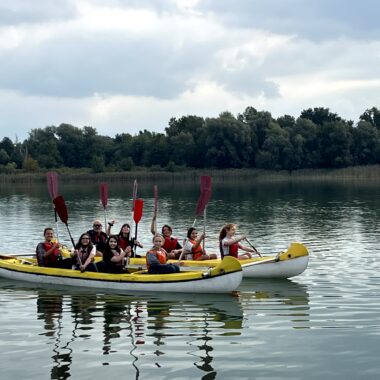
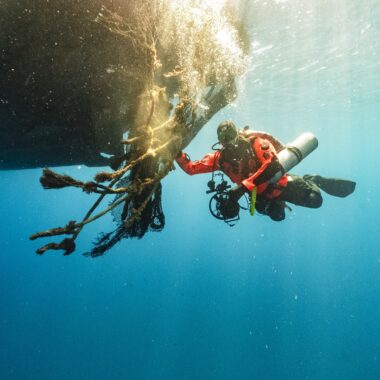
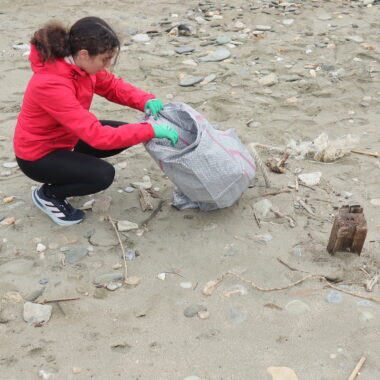
Since 2024, Aristea and her team have worked alongside the Healthy Seas education team to design and deliver outdoor learning programmes connected primarily to our Ghost Farms projects in Greece. While abandoned aquaculture infrastructure was being removed from nearby waters, children in the surrounding communities were learning about those same marine environments not only in the classroom, but in school grounds, on beaches and directly beside the sea.
Together, we developed the education part of “Ghost Farms – Reclaiming Waters” programme, bringing outdoor education to schools in places including Astakos, Nafpaktos, Amphilochia and Methana. Through activities such as Seaside Science, the Green Challenge and The Anatomy of the Ocean, more than 200 children and their teachers have so far explored marine pollution, biodiversity and their own relationship with the coast.
For Aristea, this approach is rooted in a simple but powerful idea: connection comes before knowledge. When children experience a place directly, learning about it becomes more meaningful and caring for it can follow naturally. We spoke with Aristea about outdoor education, ghost farms, the importance of learning beyond classroom walls and why the sea itself can become a classroom.
Interview with Dr Aristea Kyriakou, Co-Founder and Director of the European Outdoor Education Hub, Postdoctoral Researcher and Education Consultant
Tell us briefly about your organisation and what you do.
The European Outdoor Education Hub is a non-profit working internationally and based in Greece, and the first organisation in the country dedicated to bringing outdoor and nature-based education into schools in a systematic way. Our mission is easy to say and demanding to do: to bring outdoor education to every school in Greece and beyond.
In practice, we design and deliver programmes with schools, we train teachers to lead their day-to-day lessons outside, and we work with municipalities, foundations and academic and research partners so that what works in one schoolyard can be repeated in the next. So far that is 33 projects in six countries, reaching more than 14,500 people at over 200 sites.
What I do, in one line: I take the evidence on how children learn best outside and turn it into curriculum any teacher can deliver tomorrow morning, and into models a whole community can own, built on the places it already has, whether a schoolyard, a beach, a park or a forest.
Tell us about your collaboration/partnership with the Healthy Seas Foundation.
Our partnership with the Healthy Seas Foundation started in 2024, during Operation Ghost Farms. Healthy Seas was lifting abandoned fish farms from the seabed in Western Greece and wanted the children of those coastal communities to understand why. That became the school outreach programme, and I want to thank Nikos Therapos, Director of DOTANK Plus, for envisioning a synergy that has worked as well as it has.
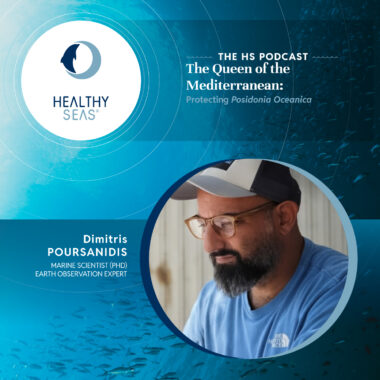
Along the way we recorded a podcast and a short documentary together, turned one lesson, The Anatomy of the Ocean, into a free guide that families can do at home, and saw the educational results presented by researcher Christina Zantioti at Aquaculture Europe 2025 in Valencia. It is a partnership that keeps growing, because both sides want the same thing: a culture that treats the sea as home.
What does the ocean mean to you personally?
Home, for me, is anywhere I can feel connected to the sea. I was born in Chalkidiki, a place inseparable from the water, and I live in Thessaloniki, a city built to face it. I did my doctorate in Aberdeen, where the North Sea sets the mood of every day, and Sweden gave me that same feeling in a colder key. Switzerland was the exception: the one place that taught me what it means to miss the sea. It did not leave me empty-handed, though; it gave me the mountains instead, and I fell for them.
So the ocean, for me, is a place and a feeling of pure openness. It is where I go to think, and the only place where I can also pause and rest.
Earth or Mars?
I have always liked the idea of extending our comfort zones into outer space. I thought I was using that as a metaphor, until I read this question. Mars would somehow be the ultimate outer space… so, hmm, thinking about it: each time I found what I was looking for, it was somewhere else, a little past the point where I felt “safe”. I have learned to read that feeling as a meaningful direction.
So, Mars, yet not as an escape. What you do not know, you can never love, and I would rather find out.
Which is your favourite place on Earth? And why?
Any school gate at the moment it opens and a class walks out. I find it deeply liberating, and leading that moment is when I feel most creative. I never get enough of it, and wherever I am it looks the same exciting: the noise changes, the bodies change, and the teacher discovers that the lesson did not fall apart.
What is one small habit everyone can adopt to help reduce ocean pollution?
Look down when you walk by the water. In our lessons we play a game called the fossil of the future: the children look for the piece of plastic that will outlive all of us. Once you have found one, you cannot stop seeing them, and you start picking them up. One piece per walk, every walk, is a habit a whole family can keep. With a dog, that is three walks a day.
What’s the most surprising thing you’ve learned about marine pollution?
Two things. The first is how quiet it is. A fish farm abandoned decades ago just sits there, nets and cages and all, still trapping life, with nobody at the surface to blame. Healthy Seas gave it a name, “ghost farms”, a term I first heard from them.
The second surprised me as a researcher. When I reviewed the evidence this year, I found that outdoor education, my own field, is still largely terrestrial. Forests, mountains, school gardens. The sea barely appears, and almost never as a learning scape in its own right. For a Mediterranean country, that is a gap we cannot afford.
What’s the most memorable thing you have experienced with/thanks to Healthy Seas?
October 2024 in Amphilochia. While we were on the beach with the fifth and sixth grade, the Healthy Seas divers were out in the Amvrakikos Gulf lifting an abandoned fish farm, and the children knew it. The clean-up was not a video projected in the classroom or a documentary on the screen, it was happening across the water from that classroom, the same week…
One evening that week the director of Healthy Seas and I walked through Amphilochia and let ourselves imagine it: if one week can do this in a life, imagine a year of days like it, and what that would mean for active citizenship when it begins this early, while you are still a student.
If you could send one message to the world about ocean conservation, what would it be?
Connection before knowledge. We keep trying to inform people into caring, and it works the other way round. Take a child to the water. Let them touch it, name what lives in it, and take responsibility for one small piece of it. The knowledge follows, and so does the behaviour. The research is clear on this, and I find it the one shift that actually leads people into action.
Can you share a moment when you felt truly hopeful about the future of our oceans?
Methana, last October. The primary school there has classes so small that we invited the kindergarten too, so that the whole school community, about fifty-five people with the teachers, walked to the sea together. Fish farming is big in that part of Greece. These children will grow up around it, and some will work in it. Watching a whole village school go to the water to learn how to look after it, with their teachers leading, is the most hopeful thing I know.
What’s the most incredible feedback you have experienced during or as an aftermath of an education project with Healthy Seas?
Sometimes we forget that feedback also comes from our own team, and from what our partners say about the work. The Methana mission was coordinated by my colleague Katerina Mouchtaridi, and her first impression was about how much it matters that a programme like this runs alongside the fieldwork of Healthy Seas.
I cannot think of better feedback than that because it supports our teams to take courage and see actually the impact in the field. When your own team finds that kind of value in a partnership, it changes what you believe is possible together with others.
How has your work with Healthy Seas changed your perspective on a particular problem or challenge?
It changed my sense of how deep a clean-up has to go. Divers can lift a ghost farm in a week. Making sure the next one is never abandoned is a generational task, and it starts in the local primary school. Restoration is not only about removing waste. It is about cultivating a new relationship with the sea from an early age.
If you could solve one issue in the education/school system instantly, what would it be?
I would open the classroom doors. In my doctoral research as an Onassis Foundation scholar, which I will soon publish as a book, teachers described their schools as a fishbowl: children contained, whole areas of the grounds locked, and a culture that treats keeping children still as keeping them safe. It is the other way round: stillness is what creates the tension. Lessons outside are cancelled before anyone has tried them, because everyone can already picture what might go wrong. Solve that one thing and the rest follows. The grounds, the beach and the forest are already there, and they cost nothing. After all, we are here to support anyone in need for this transition!
How do you see your organization evolving to support ocean sustainability in the next decade?
Two directions. First, depth. We want to move from sporadic visits to schools adopting one accessible local site, a beach, a harbour, a river mouth, as a documented, repeatable classroom, so that the sea is in the curriculum every season and not one day a year. Waterscapes as classrooms is already one of the Hub’s thematic lines, and the next ten years are about making it standard practice, with teachers trained to carry it themselves.
Second, reach. From 1 to 3 October 2027 the European Outdoor Education Conference comes to Heraklion, Crete. It is the third in an international series, after China in 2025 and Norway in 2026, and the committee behind it asked the Hub to host the next one. The programme stands on three pillars, science, policy and fieldwork. We want to leave Heraklion with commitments that can travel into policy, not only with good conversations.
What’s one thing you’d love to do with Healthy Seas in the future?
Adopt a school next to a Healthy Seas site for a whole year. The divers and the children sharing the same stretch of water, the class returning to it in autumn, winter and spring and documenting what changes, the teachers trained to run it without us. Then bring that school’s teachers and results to the world as a case study and show Europe what it looks like when conservation and learning share one location.
What is your favourite marine animal and why?
By far the octopus. It has no shell and no speed, so it survives by paying attention: it studies its place, it uses what the seabed offers, and it changes itself to fit where it is. I admire this creature so much, I think it’s incredible!
Learning Where Change Is Happening
One of the most powerful aspects of this partnership is its immediacy. During our Ghost Farms missions, environmental restoration is not something children encounter only through a photograph, a textbook or a video. In some cases, the cleanup is happening in the same waters they can see from their town, while they are learning about marine ecosystems, pollution and responsibility just a short distance away.
That connection between place, learning and action is at the heart of Aristea’s work. Her perspective also reminds us that prevention cannot rely only on better infrastructure, regulation or waste management. It is also cultural and generational. Removing an abandoned farm may take days; building a different relationship with the sea takes much longer.
At Healthy Seas, this is why education remains such an important part of our Ghost Farms work. By combining field action with outdoor learning, we can help young people understand not only what has been removed from the sea, but what needs to change so that the same problem is not repeated. And perhaps the most meaningful classroom for that lesson is the sea itself.