A New Chapter in the Journey from Waste to Wear
How hard plastic recovered from abandoned fish farms became combs, carabiners and a first test for what could come next
What happens to the hard plastic recovered from an abandoned fish farm once the cleanup is over?
Until now, much of our circularity work has focused on fishing nets. But ghost farms leave behind many other materials too, including large HDPE (hard plastic) rings and pipes that once formed the structure of aquaculture cages. In some of our recent cleanup projects, this material was already recycled locally into pellets and used to make new products, such as beer crates. Healthy Seas was not directly involved in that production process, however. This time, we wanted to take the next step ourselves: testing how material recovered during our missions could be transformed into a new, tangible object.
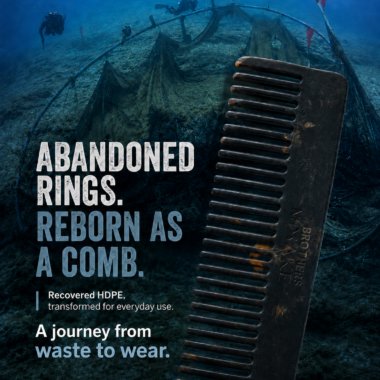
Together with a small London design studio working with recycled plastic, we carried out our first test to see whether HDPE recovered during Healthy Seas cleanup missions could become something useful again. Using existing moulds from the studio, we produced two simple objects: combs and carabiners.
50% recovered from our cleanup missions
Half of the plastic used in the objects comes directly from HDPE recovered from abandoned fish farms during Healthy Seas cleanups. The remaining 50% is recycled plastic supplied by the studio, with a lower density than the material we recovered, allowing the two materials to be combined for this first production test.
And then there are the small flashes of orange. Those orange details are recycled plastic too, added as a visual reminder of another familiar feature of abandoned fish farms: the buoys. They are another material stream we hope, in time, to find new applications for.
The result is deliberately simple: objects that still visibly carry something of where their material came from.
A journey from waste to wear and beyond
For Healthy Seas, this is only a first experiment. The combs and carabiners will now become giveaways at selected events and projects, helping us tell the story of what can happen after recovered material leaves the cleanup site.
But they may also become prototypes for something much bigger. Because the real opportunity is not necessarily to make more combs or carabiners. It is to understand what else this material could become.
Could recovered ghost farm HDPE be transformed into an object for events? A component for a partner activation? An educational tool? A useful product designed specifically around the properties of this material? That is the next question we want to explore.
Have an idea for this material?
If your company or organisation produces an object through injection moulding and you think it could be made, entirely or partly, using HDPE recovered from abandoned fish farms, we would love to hear from you.
We have the material. Perhaps you have the mould, the application or the idea that can give it its next life.Get in touch with Healthy Seas and help us explore where this journey from waste can go next.



Related stories
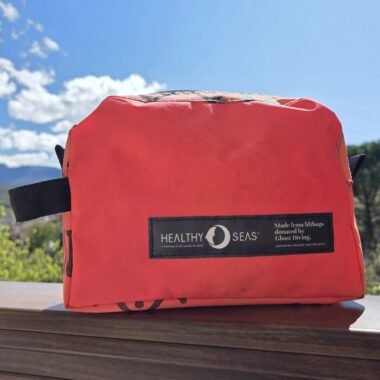
From Heavy Lifting to Carrying the Story Forward
In many of our underwater clean-up missions, some of the most important tools are not the most visible ones. When volunteer divers remove ghost nets, ropes, barrels, pipes, or other heavy marine litter from the seabed, they often rely on liftbags: strong inflatable bags that help bring heavy objects safely back to the surface. They […]

From Sea Waste to Circular Solutions: What the Circular Economy Really Means at Healthy Seas
Protecting the Ocean, One Net at a Time From the start, Healthy Seas was created with a vision that connects ocean conservation with circular economy. Our payoff—“a journey from waste to wear”—reflects this DNA. One of our founding partners was Aquafil, the company behind ECONYL® regenerated nylon. Their groundbreaking process made it possible to turn […]